
Swerve:
writing into history

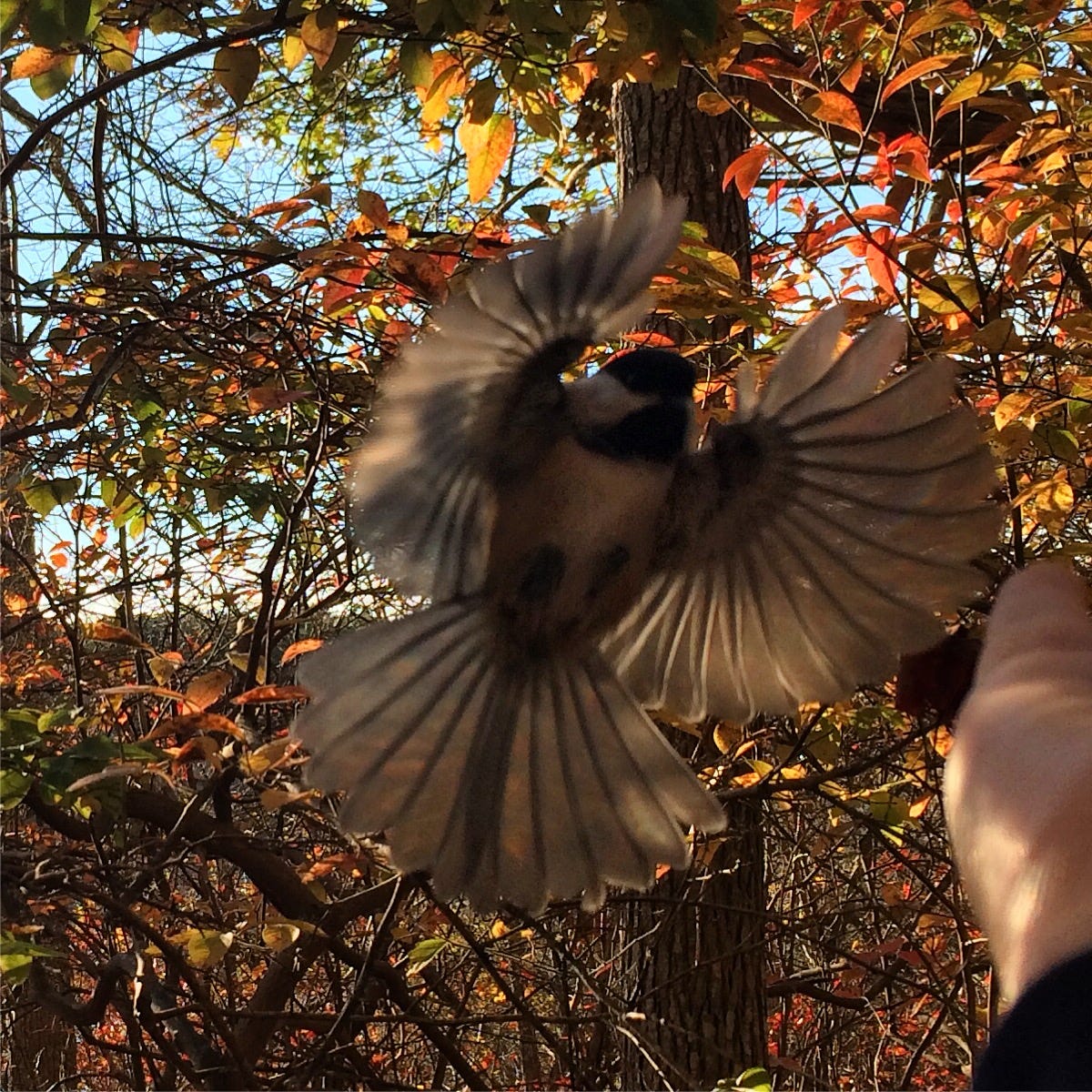
(a bird landing in my hand one November in the Beech Forest, Provincelands, MA)
For most of my adult life, I’ve been grateful for sick days and holidays as they gave me free time to write. One Thanksgiving, I abstained from all social events, thrilled that I had all day and night to write.
I had already begun writing about my Wampanoag ancestors with a poem, “Two Black Suitcases” in my first book, Underwater City.
That Thanksgiving I wrote a poem, “Swerve,” published in Poetry Magazine, reprinted in The New York Times, and included in my 3rd poetry collection, Five Kingdoms:
Swerve
I think of the man who sat
behind my grandmother’s sister
in church and told her
the percentage of Indian
in her blood, calling it out
over the white pews.
I wonder what made
him want to count it
like coins or a grade.
I wish I could hear him
now when I think of her
saying that all
the Wampanoag blood
in her body would
fit in one finger,
discounting the percentage
it seemed, but why was she
such a historian, tracing
the genealogy of the last
Wampanoag up to her own
children, typing it all on see-through
paper? Maybe like me
she felt a little self-conscious
caring about what
we’re made of
instead of simply being
satisfied dressing
our bodies and driving
them around.
Maybe she felt shy
for loving someone
she’d never met, I mean
I do. I think of the knife
cutting into flesh
and the fork carrying it
to your mouth.
I always think
of that, the scythe-
like movement,
single motion, a swerve.
I think of my relative, the “last”
Wampanoag in the town,
walking the streets
with a dollar
the town gave him.
Even then what would
a dollar buy, a finger
of land? If an Indian
could have bought land.
I think of walking
into the almshouse. The alms
falling like figs from trees,
something to gnaw on.
I think of the first time
of thanks
before it had a name,
when it was just some
relatives of mine keeping
some relatives of yours
alive through a cold winter,
people stupid enough
to take food from a graveyard,
food meant for the dead.
For seven years, I lived in Provincetown, Massachusetts, directing the Summer Program and short-term residencies at the Fine Arts Work Center. When the painter Larry Collins befriended me, we began spending every Thanksgiving together. Neither of us wanted to cook. At first, Larry ordered everything I liked from the health food store in town. But then the (wonderful) health food store closed.
We started going to a restaurant in Yarmouth, my family’s hometown, and where my Wampanoag ancestors had lived. Surrounded by families and kids and noise, it felt like we were in our own world. Nothing made me happier.
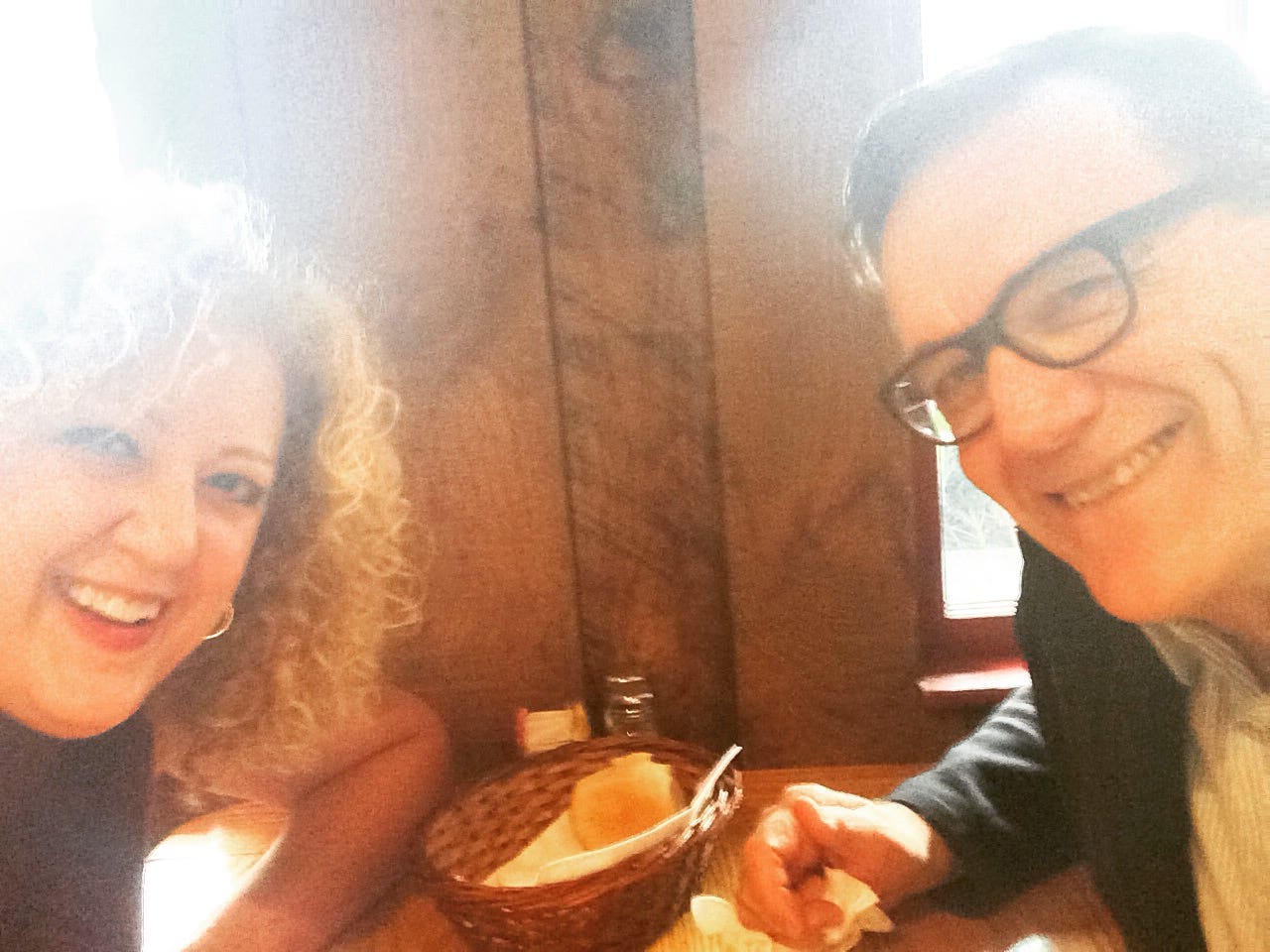
(with Larry Collins in South Yarmouth, Massachusetts on Thanksgiving.)
We always ended the day by visiting Ancient Cemetery in Yarmouth, where my mother’s family members were buried with headstones, as well as my father’s father.
We walked to the unmarked southeast corner where I’d learned through research from the Mass State Archives that my Wampanoag ancestor, Thomas Greenough, had been ordered (at 70 years of age) to dig up the graves of Wampanoag bodies which were deemed too close to the burials of white bodies, and rebury them in the southeast corner. (Thomas didn’t dig anyone up, and the Selectmen decided to do it.) In the town minutes, the Selectman ordered that all people of color be buried in the southeast corner forever after.
Larry and I would visit them. There were no graves to tend. Once we found two small pumpkins and realized someone else knows who is buried here.
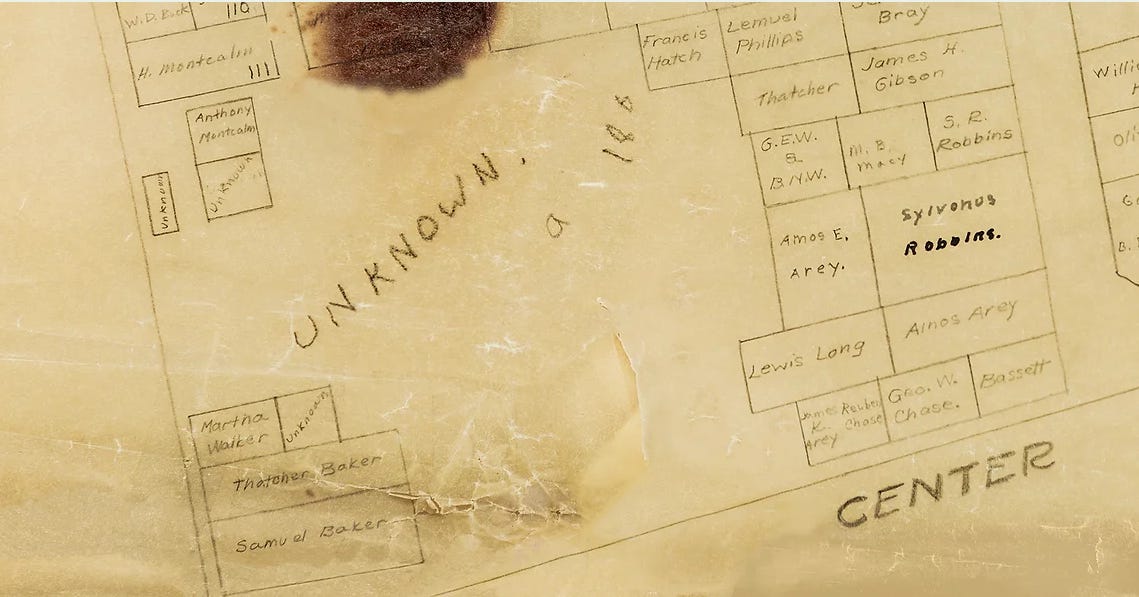
(Southeast Corner, Ancient Cemetery, South Yarmouth, MA)
In writing about Thomas Greenough and our family, sometimes my progress seems very slow, the things I don’t know enormous. But I am always headed toward him.
“Swerve” began with two things:
1). A document on see-through paper from my grandmother’s sister, Marguerite. She had traced our genealogy back to Thomas Greenough, and the paper found its way into my hands.
2). A walk with my mother across the southeast corner of Ancient Cemetery, after caring for the graves of relatives down the hill. I’d asked why, in such a crowded cemetery, this corner was empty. My mother said she’d heard that people of color were buried here, not knowing these people were her own family as well.
Is there an incident and a document/photograph related to your own historically-based interests/obsessions? Can you try writing into them to go somewhere new?
with gratitude,
Kelle
Love this poem and seeing you and Larry together! Happy Thanksgiving holiday whatever you are doing. Paul and I will light candles eat filet mignon and be grateful for each other.
Oh how I love seeing you and Larry on Thanksgiving...xo